Monday, 9 May 2016

Just a little extra...

Okay; so I really don't have much to show you in way of a new project, but I'll add a note or two on the eyes from the other day.

So I have been trying to make my sculptures a little more realistic, and one of the easiest ways to do that is to make the eyes a little more life-like. I know that it is, of course, possible to paint realistic eyes, but I find that, on the scale that I'm making them, it is too small for me to get it to a point where I am satisfied with the look of them, and maybe I am just too impatient and untalented with a brush.
My last post outlined my new approach to eyes, yes, but I still had a little experimenting to do before I was ready to show you how I 'finish' them.

I have taken the discs that I made and placed a tiny drop of resin on them to give them a domed appearance as well as a 'wet' look. Here's what I mean:


When I mentioned experimenting I was referring to not only the curing position and time but also it's resistance to heat (it is a real shame to go through all of this effort to make a perfect iris etc., sculpting a face and then having the eyes ruined when you bake the clay). Heat resistance was not something that I even really considered when I purchased my first lot of resin, I was more concerned with the clarity. 
I went through all that effort , only to have them come out all milky white instead of clear after baking. I am not ashamed to admit that I cried a little.

I know its hard to see the severity of the discolouration in this photo, but these eyes became a complete write-off...


I also experimented a bit with the curing position; mounting the discs on pins and hanging them upside down, with the hopes that they would keep a better domed shape when fully set. This is a perfectly acceptable way to try and get to your endgame, however it can quickly become rather a bit of a challenge to get the exact right amount of resin on the 'eyeball'. Too much and the drip is too long, making the eye misshapen and too little and the effect is equally devastating. 
Next you would have to consider the position on the disc. If the resin's 'drip' is slightly off center, that is to say that the peak of the dome is not directly over the pupil, it also looks horrid.
Another problem I ran into with this method was the difficulty involved with 1) keeping them perfectly still and hanging upside down while they cure and 2) ensuring that there were no bubbles trapped in the resin. Even the tiniest bubble can ruin the look of the eyes as everything is magnified by the resin. 
All in all not how I recommend doing it, not unless it works for you...

And so, having gone through a fair few trial and error processes, and having invested in some different resin, I set out to try again.

The most reliable way I found to cure them (letting them dry) was to simply have them sitting in a dish that you don't mind destroying (I use mini foil pie dishes from the cheap shop). This way the resin can easily be inspected for bubbles, and the dish can be moved safely out of harms way without compromising the integrity of your hard work. 
I should caution you not to entirely submerge the disc, but rather to use the point of a toothpick to drop tiny amounts onto them.

Finally I would suggest that you leave them to cure, out of harm's way - I cover mine to prevent dust and/or hair getting in them - for at the very least a full day before attempting to remove them from the dish or even just touching them.
My final tip would be to, naturally, follow all the instructions on the resin that you might be using, but also not to expose them to excessive temperatures for as long as possible, perhaps using the time between making and fully setting to work either on the body or the setting etc.. The one that I am using recommends that you wait at least a week.

As always however I would most strongly recommend that you find a way that works for you!

Here are a few more pictures:

The resin I used so successfully.
My foil dish with some eyes drying/curing...
A selection of ready-to-use eyes.


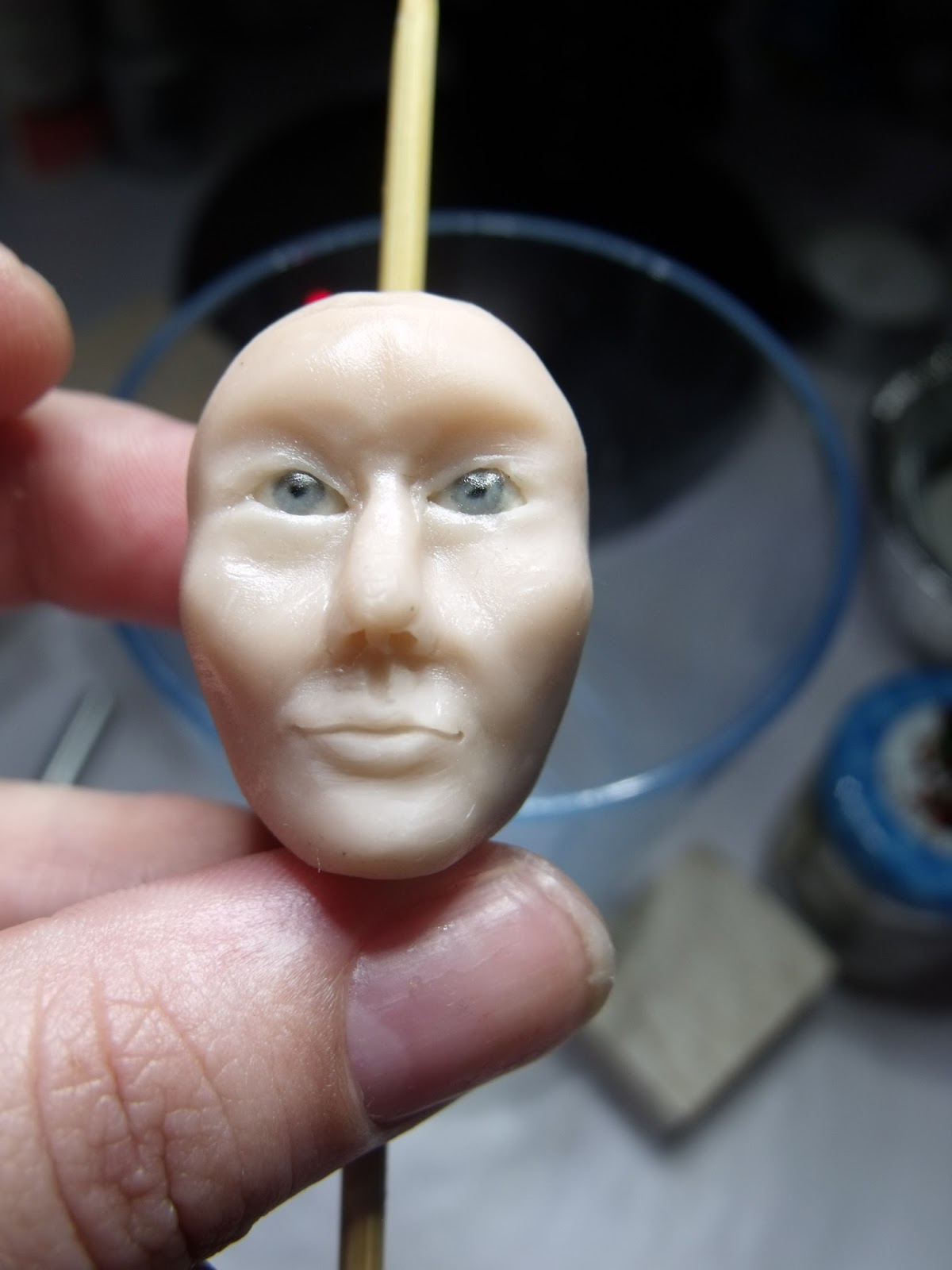
 The face above has been baked and re-baked and there appears to be no change in the eyes at all (insert a little happy dance here).

In a different light.

And, finally: a side view.


Well that's it for another day.

Until next time,
ACL.


Friday, 6 May 2016

As promised...

I have just finished making "Handsome At Every Age", a companion piece to the one I made and shared yesterday. Here he is:


Together they make quite a cute pair:


The other thing that I managed to do was make that guide to creating more realistic looking eyes. A quick disclaimer here: I took bits and pieces from all over the web to try and find a method that works for me. I suggest that rather than trying to copy these step by step, find your own way, something that works well for you.

Here we go...


(A good idea would be to find a picture of the eyes that you would like to try and replicate and match the colours of your clay with that...)
I started with about nine different shades of clay, ranging from dark to light with one of them being a complementary shade to the range of colour. For example in the blue eye there is a turquoise, in the green there is a shade of blue, and - finally - in the brown, a shade of olive.

I forgot to get some pics of the green one, but I do have one to show the colour range.


Arrange them in the order you would like, starting at the pupil and ending at the outer edge of the iris. Once you are happy with the arrangement, simply roll them out with either a pasta maker (if you have one) or, as I do, with a rolling pin.

You should end up with something like this...


What I do here is cut the ends off and then cut into four equal parts.


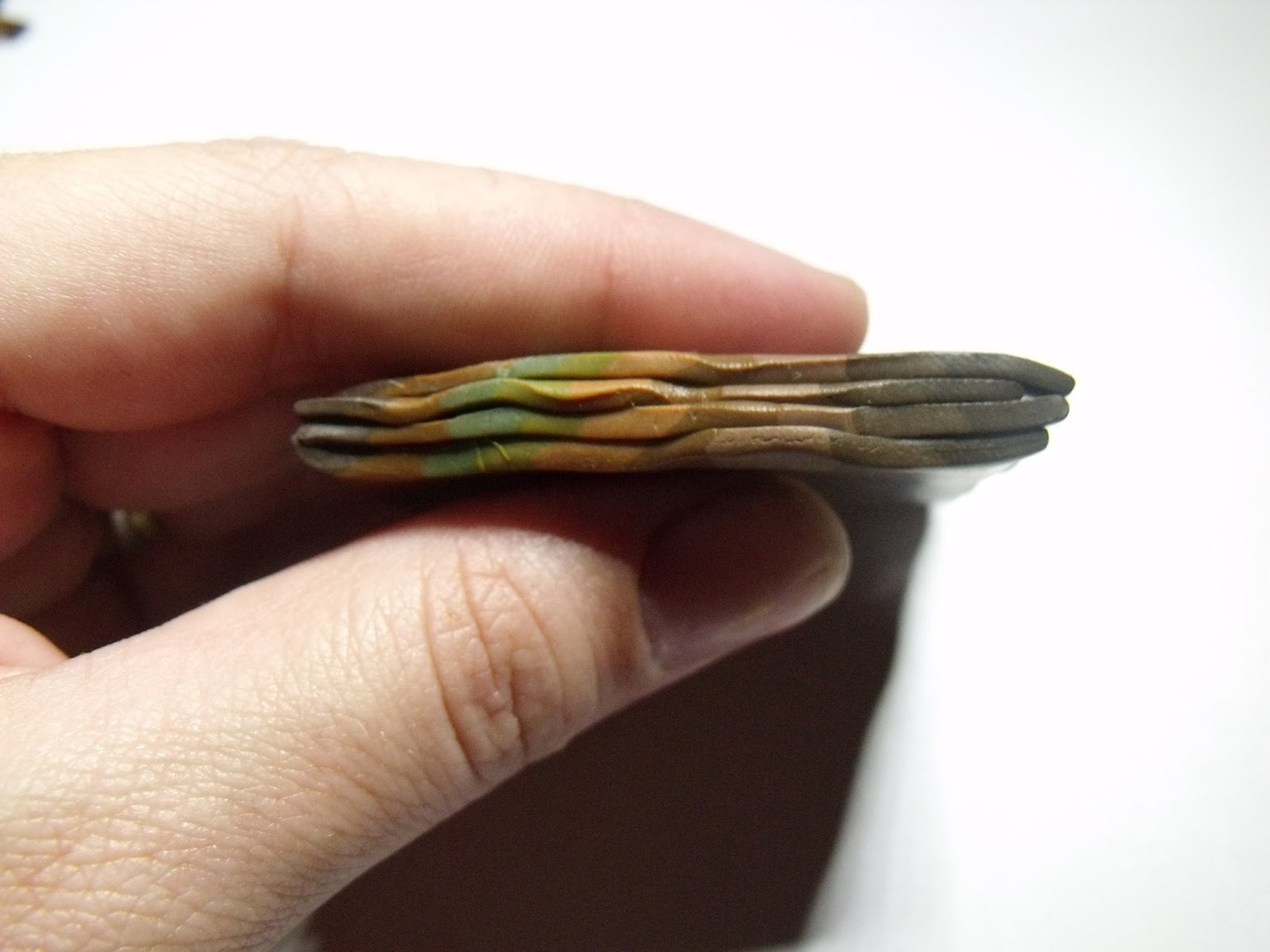
Stack these on top of one another, not quite aligned but rather staggered slightly. This is really hard to try and photograph, but here is a side view:


Grab the rolling pin and roll it out again, not too flat mind you, just enough to make sure that they stay stuck together and also that there is no air bubbles trapped in between the layers.
Once I am satisfied that it is done I                                                                       cut off the ends, cutting it in half and stacking them on top of one another, only this time they can be placed directly on top of one another.


Here's the side view.

More flattening with the rolling pin, again not too much.


Cutting the ends off again and dividing into four equal pieces.

Stack them like this, but leave the rolling pin. Now it's up to the fingers only. The idea is to stretch this out carefully. It is essential to keep the 'top' facing up - that is to say the side with the straight lines that has been facing up the whole time. If you make a mistake here, and yes: I speak form experience, it can quickly turn into an unmitigated disaster.

Try and stretch it equally and if you can, don't pull excessively on any one part.


Once stretched out to the length that you are are happy with, slightly squash the one side, forming a triangle (the part you want closest to the pupil should be the one that is squashed), cut the one end off, and then cut into pieces about 1.5 cm long (remember to discard the last bit).
(These pieces don't exactly have to be 1.5 cm, they can be any length, just so long as they are all uniform in size.)


(Almost done.) Get some black clay for the pupil and roll into a snake the approximate diameter of the pupil that you want.

Now simply stack these  coloured strips around the pupil ending up with something like this:


(Getting close to the end.) This next part can be deceptively difficult, control is the key. You'll want to now roll this into a snake or - rather cane - the same thickness as the diameter of the eye that you want. Please remember to thin it out evenly as you go and not to thin it out to the smallest in the middle right away even this seems to be the easiest. (Again speaking from experience.)

Cutting the cane in half every so often helps you to manage it as it gets longer.


(The finer details tend to get a little lost the smaller you go, so keep that in mind when deciding how small you want to go.)

Once you reach the desired width, slice a couple of thin slices and place on your baking surface and ensure that they are as close to perfectly round as possible. Bake as directed by the manufacturer.


Now all that is needed is sclera - the whites of the eyes. A tip for this is that the sclera is not necessarily pure/snow white, and if you use pure white, the face tends to look a little scary... So I have mostly white ball of clay that is mixed through with a bit of blue, pink, red and translucent, just to dull the brightness of the white.

I have seen plenty of tuts etc out there in which some of the artists use round eyes, or make these on glass head pins, and I did try to, but all I managed to make was a mess...
So instead I make discs.
Make a ball of white, squish it and put the iris in the middle.  Bake again.


And there you have it!

These are the ones that I used in "Beautiful At Any Age".

Well that is how I do it anyway. Hope this helps...

Until next time,
ACL.

Thursday, 5 May 2016

"Beautiful At Every Age"

Okay, here's what you have to know: I didn't start out with this in mind. In fact I had a very different idea of what I wanted to achieve. Regardless of what I wanted to do the clay just would not mould into what I envisioned, and I spent a fair amount of time trying, eventually getting fed up with the lack of results. Insert little temper tantrum and voilĂ !
I ended up with this crone bust that in a sculpture that I like to call "Beautiful At Any Age." And just so you know, I really think that she looks, well, beautiful; not of course in the traditional sense of perfection is beauty, but still in her own way.

Here she is:


I am planning on making a companion piece to go next to her, a husband perhaps.

The problem with that, however, is that throughout my life's artistic endeavors, since before always, I have only drawn/sculpted/painted etc female faces/bodies. So, yet again it seems, I am about to step over into the unknown, and in all honesty, I am rather excited. 
Is there anything more rewarding than facing a challenge and rocking it?

I'd like to share the process with you and I hope that there is something you can take away from this and incorporate into your own project. The lesson I learned is to be open to - and excepting of - change and not to get discouraged if things don't turn out exactly as I want.
Like I said, I started out with a very different idea in mind. But after a while this Crone came to be. (I'm working on an instructional post on how to make these type of eyes - it's a cane method of creating the iris, and if you don't want to wait for me, just Google it. I'm still trying to improve on it so maybe in a few days I'll have something to share.)

Adding some ears and a few more scrapes and cuts to simulate wrinkles on the skin. I love the character that the ears give her (at this point, in all honesty, I wasn't sure if she would be a he or a she, and I was toying with the idea of hair in them) and I'm kind of sorry that they are mostly lost under her hair now that she is completed.

Next I cut off most of the bamboo skewer (I was using it as a 'holder' whilst creating the face), leaving about 2cm at the bottom to help anchor it on the base , and placed her on a polymer clay base that I made. Over the top end I added some clay and baked for a final time.


Just before adding the hair I shaded/blushed her with a bit of soft pastels (around the eyes and lips, on top of and inside the ears, and a little on the moles on her shoulder and chin).

(The hair this time was not the cheap craft store stuff, but instead an unrolled ball of cotton wool. I simply cut it and shaped it as I went along.)

And finally a few accessories: some really thin (beading) wire, twisted together, forms her headpiece, and three little metal rings (also found in the beading section) for earrings (these are really hard to see/photograph, unless you are looking for them, and are just on the one ear).

And that is that, another one all done! (See the earrings?)


 Well I'm off to go and try make her companion. Wish me luck.

Until next time,
ACL.

PS I have been using a new communications platform, and if you are interested in contacting me with questions and/ or comments, find me instantly (messages are sent to my phone) here:
https://reaches.me:8443/urlchat.html?guestid=6aa28459a91aad02692a9334f633919a
 
Its a fairly unique platform with a huge range of uses, but I like the chat. Alternatively, download it form the PlayStore. Search for chatWORLD or follow this link: https://play.google.com/store/apps/details?id=com.world.chatworld&hl=en


Sunday, 1 May 2016

Finally Done!!!

I am proud to announce that my Purple Princess, Aimee, is done! She took me longer than any of my previous works and I can assure you that (although there were quite a few heartaches and some hardship along the way) I haven't enjoyed the journey of a project this much in a really long time. (Aimee is a name from apparent French origins meaning loved, and to me that seemed entirely appropriate.)

Here she is:


For those of you who might remember, the last post a made about this project, her arms sustained some serious damage in a fall (due to late nights and exceedingly clumsy artists) and I had to re-model them from scratch.


Somehow I think it might have been a blessing in disguise, as to me she looks much better (my dad asked if she was tweaking her nipple, something I had not considered when posing her as I initially did). At the time my idea was that she would be holding up a piece of her dress and wading thorough water (an idea that was later abandoned lest she forever be known as the Nipple Tweaker).

Now, for those of you who care, I will share the journey with you from start to finish (for the most part).

I did a few things differently on this one, the main difference being that she is not pose-able, meaning that unlike the other ones which could be bent at the elbows and knees, as well as turn their heads Aimee (in case you couldn't tell from the pics,) cannot move anything. She is frozen in this pose, eternally (or until she falls again).
Another marked difference in this one is that she isn't the full figure, in other words she is missing the lower half of her legs. Initially I had planned on making another complete figurine but it didn't quite work out the way I would have liked it to.
Frozen joints take quite a bit more planning and forethought, something that is more often than not lacking in my project.
Mom has a saying "What is the use of a mind if you can't change it." This pretty much underlines the way I live my life, which is not necessarily a bad thing, but nowhere in that saying does it say to also forgo the planning, something that I tend to forget about, most of my projects sort of transform and grow organically in the process of being created, and are often rather different from the vision I might have had at the start of it.

The last difference that comes to mind is the hands. This time the entire hand is on a wire frame meaning that it has 'bones' of a sort. There's what I mean:

(This is not the actual on that I used, but it gives you the general idea.)
Ohter than that I pretty much made her just like all the rest, starting with the creation of an armature. I have made a little board with some screws attached to it (thank you Morezmore for the idea, it works beautifully). I have the screws placed at the joints of a human skeleton. Here's what I mean:


This becomes the frame work from my sculpture, like so: (Note the curve in the 'spine' etc. Remember that our skeletal structure, even at rest, is never entirely flat)


Having the frame work done I simply start 'building up' the body with my polymer clay until she is fleshed out completely (except for the head and limbs which I add as one of the last steps in the sculpting part of the process).

The head, hands and (when I have them) feet are all done sepetately from the bulk of the sculpture and atatched after they are done. This just makes life so much easier and the risk of something happening to the body is also reduced.

After sculpting it's hair and paint/pastels, followed by accessories and clothes. And that's that.

However I thought I'd show you how I made the wings in a bit more detail.
They didn't turn out exactly as I would have liked, and I was thinking about redoing them, until I took the photos and shared them with Mom. It was her opinion that they look fine, and I didn't find then as offensive in the photos either (maybe it was just my subconscious' way of trying to get me to keep working on her - redoing the wings - as I loved every moment of it).

I'm not too sure what inspired me to make these particular wings, but I saw a blog on which the lady made an angel with wings and they looked awesome, and so I wanted to incorporate it into one of my own projects.
A little bit of research turned up several different tutorials from all over the internet. Here's how I did mine:

I took a few pieces of florist's wire and cut them into four equal pieces. I took said wire and folded all four of them in half and twisted them together to form one wing, repeating the process for the second wing. This is what I ended up with:


Next I found some purple cellophane sheets, some iridescent shredded cellophane, glitter, and spay adhesive (and I put the iron on so long, on a med-low setting).

Cutting the cellophane into two pieces, big enough to cover both sides of each of my individual wings I set to work. I did most of this next lot on my ironing surface and suggest that, if you try this, you do the same as moving them might be a slight problem.
I took one of the cellophane pieces and put it down flat, placed my wing on it and then sprayed it with the glue, sprinkled some glitter on it, and placed a few shreds of the iridescent cello in the mix too. Finally I carefully place the second sheet over the top and pressed down firmly.
This entire step has to be done rather quickly as the glue will dry out, making a mess, or even attract some unwanted elements into the wings, things like dust, hair etc. (those of you with fur-kids know what I'm taking about).


This last part can be really tricky and the slightest err can lead to disaster, so take your time and do it slowly, patience is the key.

I covered my wings with an old towel, but in some of the tuts that I saw online some people use parchment or wax/baking paper; I however didn't want to risk it, plastic can really wreck an iron,  then I ironed them slowly through the towel, checking periodically to make sure that they weren't getting too hot.
I put my iron on the synthetic/rayon setting (not quite the lowest but less than medium heat) and that seemed to work the best. I was not getting anywhere with the iron on the lowest setting, and didn't want to risk going too hot, thus the less than med - more than low setting I am using.
This part takes a while but I think that it might be worth it in the end. The aim is to heat the plastic and the glue just enough so that it forms a permanent bond with both sheets of cellophane effectively sealing the wire and glitter etc. in plastic wrap, but not so hot as to melt through the plastic and set the whole place on fire. A balancing act if you will.

Once I had reached the desired result, all that was left was to trim off the excess plastic and shape the wings. I used a lighter to sear the edges shut finally and give it that jagged edge that fairy wings tend to have.


Note that the part where all of the wires are twisted together are uncovered and this is the part that is fitted into the back of my figurine and secured finally with epoxy glue.
Again in some of the tutorials that I uncovered they suggest using an incense stick or something similar to put holes in the wings. I didn't want to go for that tortured look so I opted out of that.

Well there you have it. Another project completed.


Well until next time,
ACL.